Loading...

Selecting and shaping long quotes can feel like a puzzle for students striving to write standout academic papers. Strong quotations do more than fill space: they add authority and give your argument deeper roots. By learning how to identify powerful passages that deserve block quote formatting, you elevate your own analysis and meet MLA expectations. Mastering this process helps your writing stand out in American classrooms while building skills valued in every field of study.
| Key Point | Explanation |
|---|---|
| 1. Choose impactful long quotes | Select quotes that provide unique insights and support your thesis effectively. Not all passages merit lengthy citations. |
| 2. Follow MLA citation rules | Ensure accuracy in citations, including context and proper punctuation placement for both web and print sources. |
| 3. Format block quotes correctly | Indent block quotes one inch from the left margin without quotation marks, maintaining double spacing throughout. |
| 4. Smoothly integrate quotations | Use clear signal phrases to introduce quotes and follow with your analysis to show relevance to your argument. |
| 5. Verify quote accuracy | Confirm the exact wording and formatting of quotes, ensuring they meet MLA standards and support your discussion. |
Choosing the right passages for long quotes is crucial in academic writing. Your goal is to select quotations that powerfully support your thesis and provide meaningful textual evidence. Not every passage deserves block quote treatment.
To effectively select relevant quotations, focus on passages that offer unique insights or complex arguments that cannot be easily paraphrased. Look for quotes that meet these key criteria: they should introduce a critical perspective, reveal an author's distinctive voice, or present nuanced analysis that directly connects to your research argument. When evaluating potential long quotes, ask yourself whether the passage adds substantive value beyond what a brief citation could achieve.
Remember that in MLA formatting, prose quotations longer than four lines transform into block quotes requiring special indentation and formatting. Your selected passages should be precise and intentional selective snippets that illuminate your academic discussion.
Pro tip: Always read the entire context surrounding your chosen quote to ensure you represent the original source's meaning accurately and ethically.
Here is a summary that compares long and short quotations in MLA style:
| Aspect | Long Quote (Block Quote) | Short Quote (In-Text) |
|---|---|---|
| Length Requirement | Over four lines of prose | Four lines or fewer |
| Formatting | Indented one inch, no quotes | Part of sentence, in quotes |
| Citation Placement | After final punctuation | Before ending punctuation |
| Quotation Marks | Not used | Required around the quote |
| Use Case | Nuanced or complex analysis | Quick evidence or reference |
Mastering MLA source citations requires precision and attention to specific formatting rules. Your ultimate goal is to provide clear attribution that allows readers to easily locate the original source of your quoted material.
When preparing MLA in text citations, you need to include three key components: the introductory context, the direct quote, and the parenthetical reference. For printed sources, this means including the author's last name and the specific page number in parentheses. Web sources require slightly different approaches - if an author is named, use their last name; if no author is present, use a shortened version of the title. Pay close attention to punctuation placement. A full sentence introduction requires a colon before the quote, while a phrase introduction uses a comma.
Web or print, the fundamental principle remains consistent: your citation must provide enough information for readers to trace the original source in your works cited list. Ensure your parenthetical reference appears immediately after the quoted material, placed before the ending punctuation for the sentence.
Pro tip: Always double check that your in text citation matches exactly with the corresponding entry in your works cited page to maintain academic integrity.
Mastering block quote formatting is essential for presenting long quotations with academic precision. Your goal is to create a clear visual distinction that signals an extended quote to your readers.

When working with MLA block quote guidelines, you must follow specific indentation and spacing rules. Block quotes begin on a new line, indented one full inch from the left margin. Unlike standard quotes, you will not use quotation marks. The entire quote should be double spaced, matching the rest of your document. The parenthetical citation appears after the final punctuation of the quote, which helps maintain a clean and professional academic presentation.
Pay special attention to the overall layout. The block quote should maintain the same font and size as your main text, creating a seamless yet distinct visual element. Your quote should be integrated naturally into your argument, serving as textual evidence that supports your academic analysis.
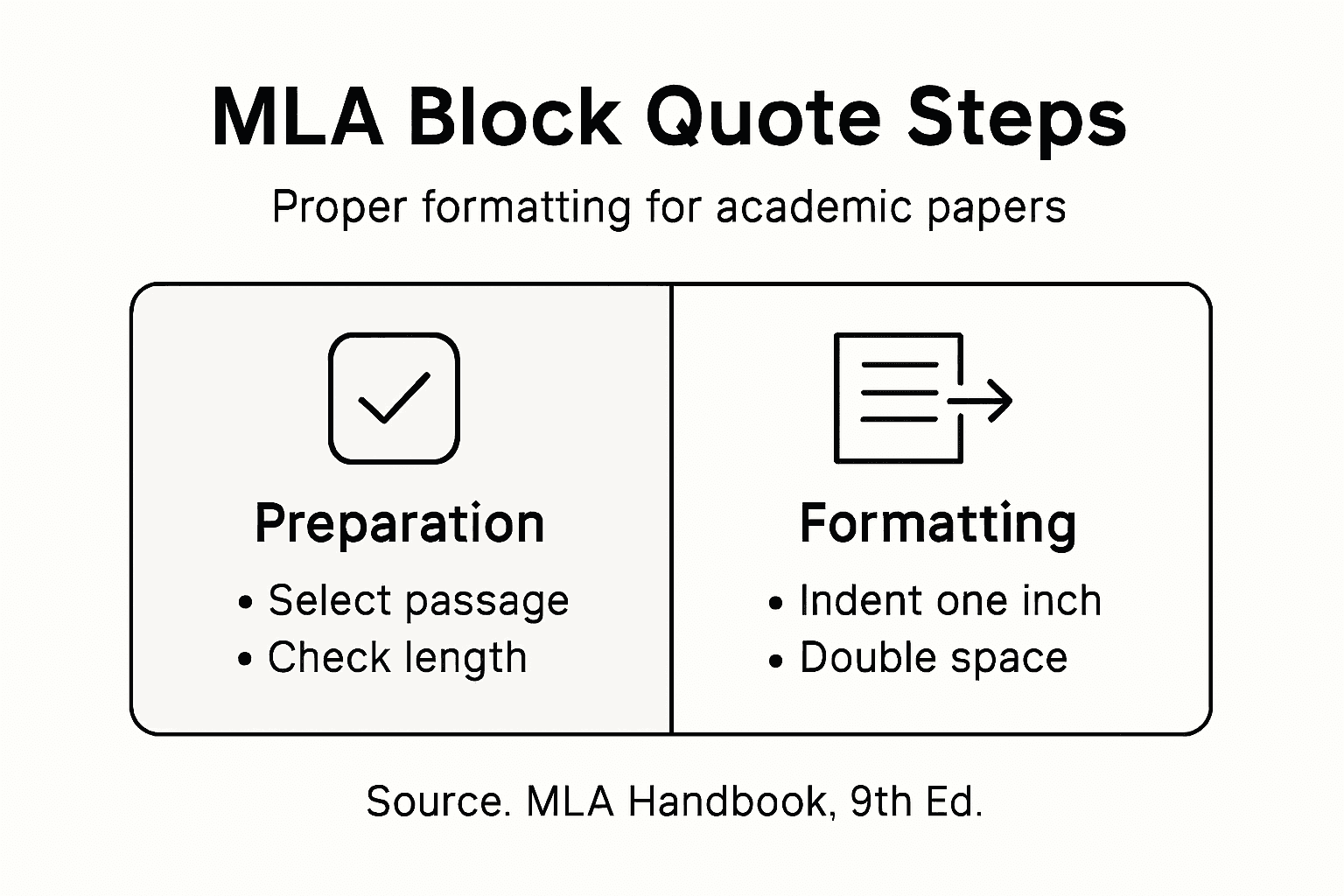
Pro tip: Always measure your one inch indentation precisely using your word processor's ruler function to ensure consistent formatting across your entire document.
Quoting effectively is an art that transforms your academic writing from simple reporting to nuanced analysis. Your goal is to weave quotations seamlessly into your argument so they feel like a natural extension of your own scholarly voice.
Integrating quotations strategically requires more than simply dropping a block of text into your paper. Begin by introducing the quote with a clear signal phrase that provides context. This means explaining who is speaking, why their words matter, and how they connect to your broader argument. Your introduction should create a smooth transition that prepares readers for the upcoming quotation. After presenting the quote, immediately follow with your own analysis that explains how this evidence supports your thesis. Think of the quote as a conversation partner rather than a standalone statement.
Remember that quotes should amplify your argument not overshadow it. Each long quote you select should offer unique insight that cannot be easily paraphrased. Your commentary should interpret the quote critically revealing its significance to your research and demonstrating your intellectual engagement with the source material.
Pro tip: Read your quote and its surrounding text aloud to ensure the integration sounds natural and flows smoothly from your own writing.
Ensuring the absolute precision of your long quotes is a critical step in maintaining academic integrity and scholarly credibility. Your mission is to create a flawless representation of the original source that meets every nuanced requirement of MLA formatting.
Verifying quote accuracy demands meticulous attention to detail. This means reproducing the original text exactly as it appears in the source document word for word. Pay careful attention to original spelling punctuation and capitalization. If you need to omit words use ellipses precisely and sparingly. Check that your block quote follows MLA guidelines by confirming a one inch indent from the left margin and maintaining consistent double spacing. Verify that your parenthetical citation appears after the final punctuation and includes the correct author name and page number.
Beyond formatting your verification process should include a comprehensive review of context and relevance. Confirm that the quote genuinely supports your argument and that you have provided sufficient analysis to demonstrate its scholarly significance. The quote should feel like an integral part of your academic narrative not an isolated piece of text dropped without explanation.
Pro tip: Create a side by side comparison of your quoted text with the original source to catch even the smallest formatting or transcription errors.
The following table highlights common MLA citation errors and how to avoid them:
| Common Error | How to Avoid | MLA Requirement |
|---|---|---|
| Citation after punctuation | Place citation before punctuation | Citation inside sentence period |
| Missing author name | Always include author's last name | Author and page always required |
| Incorrect indentation | Use word processor ruler | One inch from left margin |
| Unmatched works cited entries | Verify citations match sources | Every citation must correspond |
Struggling with MLA formatting for long quotes can slow down your research paper and introduce costly errors like incorrect indentation or citation placement. This article highlights key pain points such as precise source citation, smooth quote integration, and absolute formatting compliance. If you want to eliminate guesswork and elevate your academic writing quality while securing your paper’s credibility, help is just a click away.
Unlock powerful assistance with Samwell.ai, an advanced AI-driven platform that streamlines your essay and research paper writing. Whether it is handling complex MLA formatting or generating well-cited paragraphs, Samwell.ai’s unique Semihuman.ai technology ensures originality and precise adherence to citation standards. Explore features like the 'Power Editor' for perfecting your content and 'Guided Essays' for structured support. Take control of your writing process today and produce flawless, academically sound papers. Visit Samwell.ai now and transform your research with intelligent, seamless assistance.
Block quote formatting in MLA style requires you to indent the entire quote one inch from the left margin, double space it, and avoid using quotation marks. Begin the block quote on a new line and place the parenthetical citation after the final punctuation. Ensure these details to accurately present your long quotes in academic writing.
To integrate long quotes seamlessly, start with a clear introductory phrase that provides context. This approach helps the quote flow naturally with your argument and prepares readers for its significance. Immediately follow with your own analysis to clarify how the quote supports your thesis.
To verify the accuracy and compliance of your long quotes, reproduce the original text word for word, checking for spelling, punctuation, and capitalization. Confirm that your formatting, such as indentation and spacing, meets MLA guidelines to maintain academic integrity. Compare your quoted text side by side with the original source to catch any errors.
When choosing passages for long quotes, focus on those that provide unique insights, complex arguments, or a distinctive voice that supports your thesis. Ensure the passages add substantial value and cannot be easily paraphrased, reinforcing your academic discussion.
For long quotes, your in-text citation should include the author's last name and the specific page number immediately after the quote’s final punctuation. Use a colon to introduce the quote following a full sentence, or a comma before if it’s a phrase introduction. This ensures that readers can easily locate the source information.
Common mistakes include placing the citation after the terminating punctuation and omitting essential details like the author's name. Always double-check that your formatting aligns with MLA guidelines to provide accurate citations, ensuring clarity and academic rigor in your writing.